
Traditional Balsamic Vinegar of Modena & The Municipal Vinegar Cellar
What is Traditional Balsamic Vinegar of Modena?
“Traditional Balsamic Vinegar of Modena is obtained from cooked grape must, matured through slow acetification derived from natural fermentation and progressive concentration via exceptionally long aging in a series of wooden casks (vaselli) made from different woods, with no added substances whatsoever.
Deep, dark brown and glossy, its density displays a proper, smooth syrupy texture. It features a characteristic, complex, penetrating aroma with a distinct yet pleasant and harmonious acidity. Boasting a traditional, inimitable, and well-balanced sweet-and-sour flavor, it presents itself generously full and savory with velvety undertones, in complete harmony with its distinctive olfactory traits.”
The story
It is the quintessential sweet-and-sour product of the Modenese culinary tradition, ranked among the most precious in the world.
“Historical records regarding Traditional Balsamic Vinegar of Modena are extremely numerous. The term 'balsamic' alongside the word 'vinegar' appears for the first time in the 1747 register of grape harvests and wine sales for the Ducal Secret Cellars (Archivio di Stato, Modena). Nevertheless, the tradition of producing this 'most particular' balsamic vinegar within a fairly contained area like the province of Modena is so ancient that precise records date back to 1508 at the court of the Duke of Modena, Alfonso I d’Este, husband of Lucrezia Borgia.
Furthermore, 16th-century and 1796 documents and manuscripts refer to fully ripened musts used to produce Modenese-style balsamic vinegar, as well as the topping-up (rincalzi) of the 36 barrels kept in the third tower of the Ducal Palace facing St. Dominic. It is interesting to note how these early records consistently highlight two fundamental constants for the production of Traditional Balsamic Vinegar of Modena: cooked must made from typical grapes grown in the province of Modena as the base product, and the location of production facilities in elevated spaces, generally in attics.
The first formal codification of Traditional Balsamic Vinegar of Modena production comes from a handwritten letter sent in 1862 by Francesco Aggazzotti to Pio Fabriani. From that date onward, documentation regarding its production grew rapidly and became more official thanks to commercial distribution: the 1863 Agricultural Exhibition in Modena, the 1888 Emilian Exhibition in Bologna, and printed brochures from the era stating that balsamic vinegar is a Modenese specialty made from selected grapes.
In conclusion, these historical testimonies confirm that a unique type of vinegar unknown in other regions has been produced in the province of Modena since time immemorial, with production and aging characteristics that have remained virtually unchanged to this day and are now enshrined in the official Production Regulations for Traditional Balsamic Vinegar of Modena.”
How It Is Produced
Traditional Balsamic Vinegar of Modena is produced through distinct, carefully executed phases:
- Pressing: Grapes grown in the province of Modena specifically Lambrusco and, above all, hillside Trebbiano are pressed to extract the must.
- Cooking the Must: The must is simmered for several hours over a direct flame in a open cauldron to concentrate its natural sugars.
- Fermentation: Following cooking, microorganisms known as yeasts and acetic bacteria initiate fermentation within the concentrated must. During this lengthy process, key transformations yield alcohol and acetic acid, developing the initial aromas of Traditional Balsamic Vinegar of Modena.
- Maturation: Following fermentation, crucial transformations driven by enzymes establish the signature traits of Traditional Balsamic Vinegar of Modena: its color, aromas, and flavor profile.
- Aging: Through interaction with oxygen, further concentration occurs over a very long process until the final product is achieved. Maturation and aging take place in sets of small casks (botticelle or vaselli) crafted from various woods (oak, chestnut, mulberry, cherry, and juniper).
Visitor Information
- Address: Via Abetone Superiore 169, San Venanzio, Maranello
- Free Tours & Tastings: Every Sunday in June, July, and September from 10:00 AM to 12:00 PM.
- Guided Tours by Appointment: Available daily by reservation through the Maranello Public Relations Office (URP - Ufficio Relazioni con il Pubblico), Piazza Libertà 33, Tel. +39 0536 240 000.
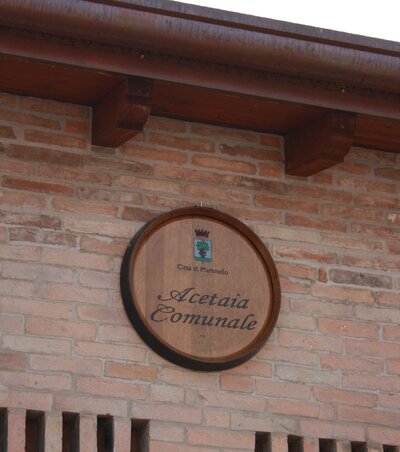
The Municipal Vinegar Cellar (Acetaia Comunale) is owned by the Municipality of Maranello and managed by the Committee of the Municipality of Maranello for the Promotion and Enhancement of Typical Modenese Products.
Source: Municipality of Maranello website