WHAT YOU CAN SEE IN MARANELLO...
Yes, the story of how Ferrari chose Maranello as its headquarters is truly intriguing! Maranello became the home of Ferrari thanks to the vision of Enzo Ferrari. After World War II, Ferrari decided to move operations from the original site in Modena to Maranello. In 1943, Enzo Ferrari built the factory there, which became operational in 1946.
The choice of Maranello was no coincidence. The location offered the space needed to build modern production facilities and a test track. Furthermore, Maranello was close enough to Modena, allowing Enzo Ferrari to maintain close ties with the heart of the Italian Motor Valley.
From a strategic point of view, Maranello turned out to be perfect, and to this day, it is synonymous with automotive excellence and innovation. Every time a Ferrari leaves the factory, it carries with it a piece of Maranello's passion and history.
If you're interested, I can tell you more about other fascinating aspects of Ferrari's history!
The Prancing Horse: The famous Ferrari logo, the prancing horse, has an interesting history. The emblem was originally painted on the fuselage of the plane flown by World War I Italian fighter pilot Francesco Baracca. Baracca's mother suggested to Enzo Ferrari that he use it as a good luck charm for his cars. Since then, the prancing horse has become one of the most recognizable symbols in the automotive world.
Scuderia Ferrari: Founded in 1929, Scuderia Ferrari did not initially manufacture its own cars, but instead prepared and raced Alfa Romeo vehicles. It was only after World War II that Ferrari began producing its own racing and road cars.
Formula 1 Record: Ferrari is the most historic and successful team in Formula 1 history, with numerous World Championships won in both drivers' and constructors' categories. Their first Drivers' Championship title came in 1952 with Alberto Ascari.
Iconic Models: Ferrari has produced some of the world's most iconic and coveted models, such as the 250 GTO, the Testarossa, and the LaFerrari. Each model represents the pinnacle of automotive engineering and design of its era.
Continuous Innovation: Ferrari has never been content to rest on its laurels. The company continues to innovate and push the boundaries of automotive technology in both road and racing cars.
The Ferrari Museum: A visit to the Ferrari Museum in Maranello is a must. The museum offers a historical overview of the most iconic cars, trophies, engines, and countless memorabilia that tell the remarkable story of the brand.
Fiorano Circuit: Ferrari owns a private test track called Fiorano, located near the Maranello factory. This track is used to test and develop vehicles, ensuring every Ferrari is fine-tuned for peak performance.
Ferrari Clients: Owning a Ferrari is a symbol of prestige. The company maintains a strong relationship with its clients, offering exclusive experiences such as the Ferrari Classiche program which helps maintain and restore vintage Ferraris and the iconic Ferrari Cavalcade, an event bringing Ferrari owners together for a special tour through picturesque landscapes.
Ferrari is also at the forefront of adopting eco-friendly technologies. For instance, the Ferrari SF90 Stradale is a plug-in hybrid car that combines breathtaking performance with reduced environmental impact.
Enzo Ferrari: Even after his passing in 1988, Enzo Ferrari's spirit and vision continue to guide the company. Every new car reflects his commitment to excellence and passion for motorsport.
Ferrari is more than just a car manufacturer; it is a global icon that embodies luxury, performance, and innovation.
Maranello, the story
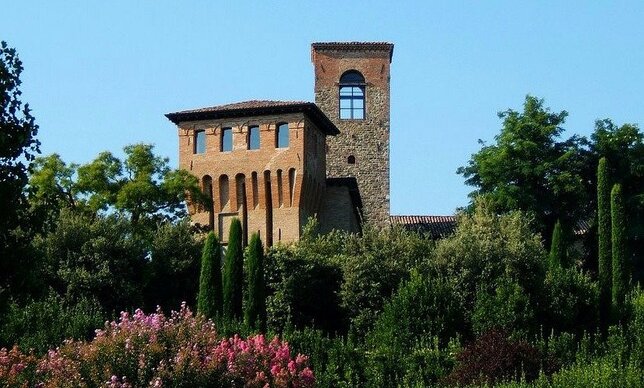
The castle
Maranello
is an Italian municipality of 17,309 inhabitants (ISTAT 2022) in the province of Modena in Emilia-Romagna, located south of the provincial capital. Since 1943, it has been home to the factory of Ferrari, the prestigious luxury sports car company founded by Modena native Enzo Ferrari. In 2009, by decree on December 16, the President of the Republic Giorgio Napolitano conferred the title of city upon the municipality of Maranello.
Story
Maranello is located in Emilia, about 18 km south of Modena along Provincial Road No. 3, also known as Via Giardini. It is a municipality in the foothills and forms part of the ceramic district alongside the municipalities of Sassuolo and Fiorano Modenese. The main town center is nestled between the first rising hills leading up to the Emilian Apennines and the plains filled with farmland and factories. Visitors are often struck by a somewhat surreal landscape, where agriculture and livestock farming coexist side-by-side with cutting-edge industry.
As a production area for Balsamic Vinegar, Parmigiano Reggiano, and Modena PDO cured ham, Maranello boasts a history that stretches deep into the past. Archaeological finds document this history back to at least the Bronze Age (1800–1000 BC), alongside numerous artifacts from much earlier eras. It is known with certainty that there were settlements of Ligurian origins (Ligures friniates), which the Roman legions gradually subjected between 189 and 179 BC during their conquest of Italy. Confirmation of the Roman presence remains visible today in one of the main roads running through the town, Via Claudia an ancient route, likely of Etruscan origin, used as an alternative to a section of the Via Emilia that was restored by Consul Claudius, who gave the road his name.
Of great importance was the discovery in 1987 in the locality of Torre delle Oche of the remains of a Roman-era kiln: since then, the excavations have been completed, bringing to light the entire structure along with numerous artifacts, including two amphorae. The material uncovered is on display at the Archaeological Museum inside the Palazzo dei Musei on Largo Sant'Agostino in Modena.
The name Maranello most likely derives from the settlement of a family from Marano (a neighboring municipality to the south), the Araldini or Arardini, who built the castle which still stands today after being rebuilt following the earthquake of 1501. The houses surrounding the castle form the hamlet known as Maranello vecchio (Old Maranello). After various vicissitudes, the manor was purchased in 1936 by Professor Giuseppe Graziosi, a renowned painter and sculptor, who lived and worked there. Today, the castle is privately owned.
The aforementioned Via Giardini, formerly the Abetone State Road, took on major logistical importance as it is the road running directly in front of the Ferrari factory. Commissioned by Duke Francesco III to connect the Duchy of Modena with the Grand Duchy of Tuscany thereby boosting the country's economic and social development construction began in 1766 and was completed in ten years. For its time, it was a monumental undertaking, stretching nearly 100 kilometers through Modenese territory from the capital to the Tuscan border. Positioned along the route were post stations, inns, fountains, and rest stops for travelers a true highway ahead of its time. The design and supervision of the works were entrusted to the engineer Pietro Giardini, who employed 3,000 workers on the project. The Duke, thrilled with the result, named the road after its creator.
Thanks to this road and its setting at the foot of the Tuscan-Emilian Apennines, Maranello earned a reputation among locals in Modena as a lovely spot for a holiday getaway. The town as we know it today referred to for many years as Maranello nuovo (New Maranello) developed at the intersection of Via Giardini and Via Claudia. In addition to the central town core, the Municipality of Maranello also encompasses the hamlets of Pozza, Gorzano, Torre Maina, Torre delle Oche, San Venanzio, and Fogliano.
On February 1, 1931, the Municipality was granted the right to use its official coat of arms. The grant decree reads as follows: "Silver, a pear tree fruited in its natural state, growing on a green plain, with a vine fruited in black twined around the tree." The tree represents the strength of the Municipality, the pears and grapes reflect the agricultural nature of the land, and the tree taking root in the meadow symbolizes the region's fertility; the crown represents the Municipality's autonomy. (In March 2000, a mosaic depicting the Maranello municipal coat of arms was installed in the central Piazza Libertà. Created by master craftsman Montanari, the artwork comprises 16,000 pieces of marble and semi-precious stones nearly one for every resident of Maranello sourced from various countries around the world to highlight Maranello's openness to others.)
On December 16, 2009, the President of the Republic Giorgio Napolitano issued a decree conferring the title of City upon the Municipality of Maranello: through its history, social, economic, and cultural growth, and thanks to the ingenuity of figures like Enzo Ferrari alongside the skill of its technicians, artisans, and workforce, Maranello stood as an exemplary symbol of Italy's post-war industrial expansion. This honorary title of City also brought a modification to Maranello's coat of arms: the crown is no longer simply embattled, but now adorned with towers.
Town center
Located in the center of Maranello, built between 1894 and 1903, stands the parish church—a new focal point of community life for the town as it began expanding near the intersection of Via Giardini and Via Claudia. The bell tower was erected a few years later, between 1909 and 1913.
Also in the center of Maranello, besides the Piazza Libertà Mosaic (created in 2000, depicting the municipality's coat of arms), visitors can admire the monument to Enzo Ferrari by Modenese sculptor Marino Quartieri. Meanwhile, the Prancing Horse monument, created by Albanian-born sculptor Helidon Xhixha, is situated near the production facilities and the Wind Tunnel.
Also worthy of note is the small, picturesque castle (originally built around the year 1000 and reconstructed in the 16th century) located on the hill overlooking the town center.
Tourists and fans travel from all over the world to visit the Ferrari Museum, which showcases historic models, engines from sports and competition cars, as well as trophies, cups, racing suits, and helmets that document the story of one of the oldest teams in Formula 1.
Opposite the entrance to the Ferrari factory (itself a major photo spot for tourists) sits the famous Ristorante Cavallino, where Enzo Ferrari kept a private room reserved for himself, now managed by renowned Modenese chef Massimo Bottura.
Of significant architectural interest is the Wind Tunnel designed by Renzo Piano, inaugurated in 1997 on Via Grizzaga near the Ferrari facilities: inside the wind tunnel, vehicles are tested on a rolling road synchronized with wind speeds. On-track testing, on the other hand, takes place at the nearby Fiorano Circuit (adjacent to the Maranello plants, heading toward Sassuolo).
Other buildings within the Ferrari facilities were designed by prestigious architects: the research center by Massimiliano Fuksas, the new mechanical department by Marco Visconti, the new logistics and racing department by Luigi Sturchio, and, most recently, the vehicle assembly facility designed by architect Jean Nouvel.
The municipality features a library with a collection of around 44,000 volumes, alongside audiovisual materials and periodicals. Services offered include reference assistance, local lending, and interlibrary loans.
In the autumn of 2011, the entire library collection was relocated to its new headquarters designed by Arata Isozaki in collaboration with Andrea Maffei distinguished by the curved design of its glass walls and operational since November 19, 2011.
Events
Maranello, Land of Motors (Terra di Motori): An event dedicated to the passion for motorsports and road safety, featuring themed exhibitions and gatherings. It takes place on a Sunday in May.
June in Maranello (Giugno Maranellese): Entertainment, live shows, and street market stalls fill the central streets and squares every weekend throughout June.
Red Night of Maranello (Notte Rossa di Maranello): Held in June, this signature event celebrates the Ferrari myth with motor displays, shows, music, and street performances.
Grand Prix of Taste (Gran Premio del Gusto): An annual culinary event taking place on the first Sunday of October in the town's central square.
"Città dei Motori" International Trophy: An Under-13 youth football tournament organized by A.T.O.M. Srl.
Formula 1 Race Broadcasts: Every Formula 1 Grand Prix race Sunday, the event is screened live for free at the Auditorium Enzo Ferrari.
Suburbs
In the hamlets, many of which still retain their rural charm from before the industrial era, notable landmarks include the parish church of Fogliano with records dating back to 963 along with the medieval Torre de' Pietrobonis and the Church of Saints Peter and Paul in Torre Maina, home to an organ dating to 1586.
Near the hamlet of Pozza lies the park of Villa Rangoni-Machiavelli, which hosts sculptures from the "Severi" contemporary art collection. The original core of over 100 works, largely sold, included major pieces by Pietro Cascella (La fontana degli sposi), Giò Pomodoro (La porta e il Sole), Yoshin Ogata (Le vie dell'acqua), and other contemporary artists (Cassani, Celiberti, Quinto Ghermandi, Guasti, Guidi, Lutz, Augusto Murer, Perez, Rotar, Davide Scarabelli, Alberto Viani, Roberto Tirelli, Baraldi, Biolchini, Di Fabio, Tinè, Natalino Andolfatto, Doyle, Legnagli, Magelli, Sac
In 2005, the villa and park were purchased by the Degli Antoni family (Guido and Cristoforo). In 2006, following an agreement between the family and the Municipality of Maranello, the park was opened to the public. In the following years, it hosted various events, including the Poetry Festival and Parco in Fiore. After a thorough restoration and enhancement project led by the Degli Antoni family, the Villa and park have been used since 2010 to host public and private events, gatherings, and ceremonies. In 2013, although commonly known as Villa Rangoni Machiavelli, the owners restored its original name: Villa Bice.
Bibliography
Silvano Soragni, Maranello: dal feudo Calcagnini… alla scuderia Ferrari, Modena, 2004
Luca Giovanelli, Maranello. Immagini tra vecchio e nuovo millennio, Brescia, Omniadvert, 2005
Silvano Soragni, Maranello: dal castello feudale… al maestro Giuseppe Graziosi, Modena, Artioli, 2007
Silvano Soragni, Maranello: 1860… da libero comune a laboriosa città, Modena, Artioli, 2011
Laura Cristina Niero (ed.), Viva l'Italia, viva l'Annessione, Modena, 2011, Published by the Municipality of Maranello
- Sources: Wikipedia (January 7, 2025); Municipality of Maranello (January 7, 2025)